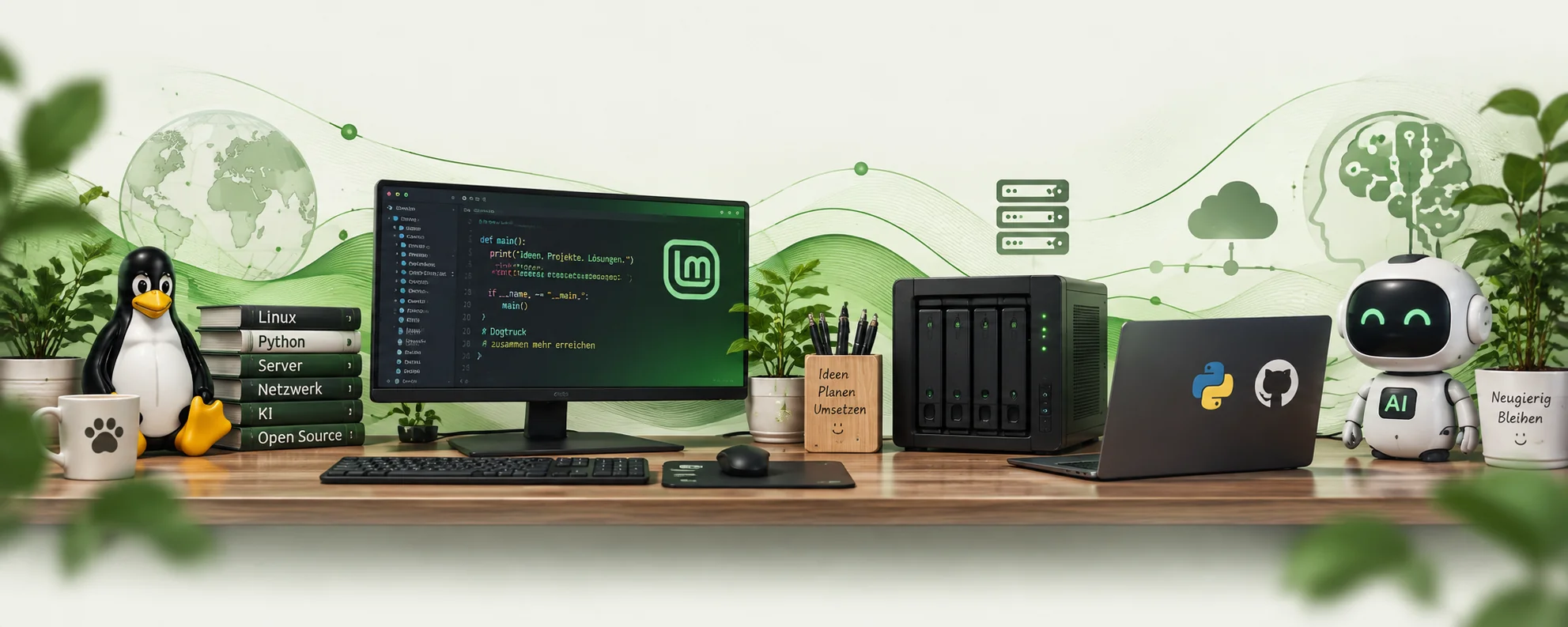
About me

Technology does not have to be more complicated than it is
I am Josef, and I run Dogtruck as a private, non-commercial website.
I am not a software company or a professional IT service provider. Many of the topics on this site began for a very simple reason: I wanted to do something on my computer, and the existing solution was too complicated, impractical or simply not what I was looking for.
So I started looking for solutions myself.
From Windows to Linux

I originally come from the Windows world. I started with Windows 98 and stayed with Windows through its various versions up to Windows 10.
For a long time, Linux was something that existed somewhere on the sidelines. My computer ran Windows, I knew the system and initially had no particular reason to change anything.
That changed with the hardware requirements for the next generation of Windows.
My computer was still perfectly adequate for my purposes and was not even particularly old. Nevertheless, it did not meet Microsoft's requirements for a standard upgrade.
To me, the message sounded roughly like this:
“Your computer still works -- but it is no longer good enough for the new Windows.”
I did not want to simply accept that. Replacing a working computer just because the operating system introduced new requirements did not seem sensible.
So a different question arose:
If Windows is no longer an option -- what next?
That was the beginning of my journey to Linux Mint.
What initially seemed like an alternative gradually became my normal working environment. Looking back, the message that my computer was unsuitable for the next Windows version was therefore less an ending than a beginning.
Microsoft wanted a newer PC. I tried a new operating system instead.
From Linux Mint to my own tools
Linux Mint gradually brought more and more topics into the picture: backups, NAS and servers, virtual machines, networks, SSH, websites and finally my own programs and scripts.
For me, the point is not to use as much technology as possible. Quite the opposite: a solution should be understandable and work in everyday life.
If a task constantly requires complicated terminal commands, I eventually find myself asking:
Why is there not simply a button for that?
Many of my Python programs and scripts grow out of questions like these.
Try it first, then write about it
Not everything works on the first attempt. Sometimes something goes wrong; sometimes a supposed improvement leads to the next problem.
That is why I now have a separate virtual test environment. New programs and changes can be tried there before they reach my main computer.
The articles on Dogtruck also grow out of this practical experience. I do not write about how something ought to work in theory, but, as far as possible, about what I have tried myself and what happened along the way.
And then AI came along

AI changed the way I work once again.
It helps me with research, programming, troubleshooting and developing new ideas. However, I quickly learned that AI also needs clear rules -- and that “improving” something does not automatically mean everything is better afterwards.
This led not only to new projects but also to stories such as “The AI and Her Brother”.
For me, AI does not replace thinking or checking things myself. It is a tool -- a rather interesting, sometimes surprising and occasionally stubborn tool.
Why Dogtruck?
Dogtruck is therefore not a glossy technology portal.
The site is more like my workshop notebook on the internet: experiences, mistakes, solutions, programs, scripts and thoughts that may help other people too.
You do not have to copy everything. But perhaps someone will find precisely the idea or solution they have been looking for.
And if something does not work?
There must be some way to make this work.