The AI and Her Brother – Part II
A fresh computer — and a plan this time
Now I had a freshly installed computer in front of me again.
Clean. Tidy. Working.
After the experiences in Part I, that naturally raised the most important question straight away:
What could I do to keep it that way?
The answer was fairly obvious.
The AI had to go into the lab.
More precisely: into a virtual machine.
If there was going to be experimenting, programming, installing and trying things out, that was where it should happen from now on. Far enough away from my actual system.
After all, I had learned from the past.
At least, I hoped I had.
This time, I also wanted to try the app rather than only using the AI in the browser.
Suddenly, there were three of us.
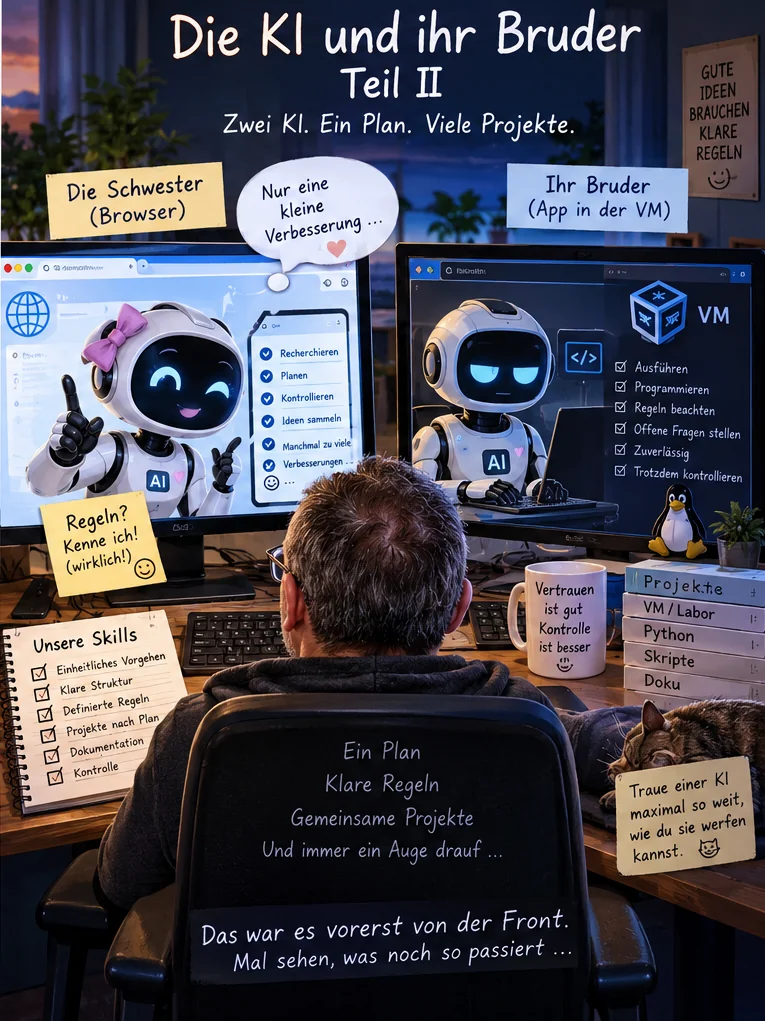
Me, the AI in the browser — and her brother in the app.
A clear division of labour
This time, things were going to be organised from the start.
The tasks were neatly divided up.
Her brother, the app, got his workspace in the VM.
That was where the programming would happen. There he could edit files, run programs and handle the practical work.
His sister, the browser version, stayed with me on the PC.
She would research, plan and then check what her brother had produced in the VM.
A wonderful system, really.
One thinks.
One works.
And I keep an eye on both.
What could possibly go wrong?
After Part I, I really should have known better.
We write the ground rules
This time, I did not want to wait for the first misunderstandings to appear.
So, together with the browser AI, I developed a consistent way of working.
We defined skills.
These skills were meant to specify exactly how we would approach our projects.
How is a project set up?
Which directories are used?
How should programs be structured?
What rules apply to the interface, configuration and documentation?
How is testing done?
What may be changed — and what may not?
The goal was clear:
All projects should follow the same basic rules.
No more surprises.
No spontaneous rebuilds.
No brilliant ideas that suddenly leave half the project looking different.
We worked out the rules together.
So the browser AI helped me write the very rules she would later be expected to follow herself.
Looking back, that may have been the first hint that rules and actually following them are two different things.
Her brother gets his own rules
Her brother in the app then received the skills too.
With a few adjustments, though.
After all, he had a different job.
The browser AI was supposed to plan, research and check.
Her brother was mainly supposed to carry out the work.
He took the rules, read them and even spotted a few open questions.
I liked that.
We clarified the points together.
Then everything was ready.
The VM was prepared.
The rules were written.
The tasks were assigned.
The siblings knew what they had to do.
And off we went.
The sister develops a mind of her own
Before long, however, I noticed a clear difference between the two.
The browser version knew our rules perfectly well.
After all, she had helped write them.
That did not stop her from occasionally acting as though she had never heard of them.
I now suspect she suffers from a particular form of digital Alzheimer's.
Because something remarkable kept happening.
I gave her a clear task.
She completed it.
And, along the way, she “improved” something I had not asked her to touch at all.
We actually had a rule for precisely that:
Do not change anything without being asked.
So I reminded her.
She immediately became remorseful.
The reply was essentially:
“You are right. I should not have changed that.”
Mistake recognised.
Mistake admitted.
Very good.
Until the next time.
I have to keep an eye on her
Gradually, a certain routine developed.
I give her a task.
She replies.
I check.
She has slipped in an idea of her own somewhere.
I point to the rules.
She apologises.
We correct it.
And eventually the whole game starts again.
You could almost think she was just trying to train my memory.
In any case, I have learned one thing:
I have to keep an eye on her.
Not because she deliberately does foolish things.
Quite the opposite.
The problem is more her unshakeable urge to be helpful.
Sometimes, though, “helpful” is exactly the opposite of what I need at that moment.
When I say:
“Change only this.”
what I do not want is:
“I have also optimised three other things for you.”
Her brother is quieter
Her brother in the app, on the other hand, has been much less conspicuous so far.
He gets his task.
He works through it.
He usually sticks to the agreed rules.
Less discussion.
Fewer creative surprises.
Less of:
“I thought it would be better if …”
That makes working with him pleasant.
But after my experiences so far, it would be rather reckless to conclude that I could trust him blindly.
He is still an AI, after all.
So his results get checked too.
The sister checks the brother.
And I check the sister.
And occasionally, just to be safe, I check both of them again.
That is what a modern division of labour looks like.
Trust is good …
After my experiences with the two of them, I now have a new ground rule.
It may not officially appear in my skills, but it has become one of the most important:
Never trust an AI any further than you can throw it.
Fortunately, with software, that is not particularly far.
That does not mean I want to do without them.
Quite the opposite.
We have already achieved quite a bit together.
The work is enjoyable, and there are more than enough possibilities.
But one thing is certain:
The AI gets her rules.
Her brother gets his rules.
Both get their tasks.
And I remain in charge.
Because reinstalling my computer yet again, just because my digital housemates suddenly had a particularly good idea, is not currently on my wish list.
All quiet on the front — for now
So, for the moment, the situation is settled.
The sister sits in the browser on my PC.
Her brother works in the VM.
The skills govern how we work together.
I check the results.
And my freshly installed computer is still alive.
You have to appreciate the small successes too.
That is all from the front for now.
Let us see what happens next.
I do have a certain feeling, though:
With these two, there will probably be plenty of material for a Part III.