
The Borrowed Memory
The first time Emil found his way to the old bathhouse, he was still wearing his slippers. He’d got up from breakfast, set his spoon beside his full cup and walked out. At the crossroads past the pharmacy, he hadn’t needed to think. Left, then through the courtyard with the crooked pear tree, then down the seven steps. Only then did he notice the snow crunching beneath his soles.
In front of him stood the wall of a car park. Emil pressed his hand against the concrete. He knew there should be a green door here. The wood above its handle was cracked, and when you pulled the door open, it smelled of damp towels and oranges. On the other side, someone always whistled the same four notes. He could have carried on the tune, but he couldn’t have said where he knew it from.
A woman carrying shopping bags stopped and asked if he needed help. Emil looked down at his feet, at the snow and finally at her face. “I’m looking for my shoes,” he said. It was the first explanation he could think of.
That afternoon, his daughter Nora brought him an electric kettle. She pretended that was the reason for her visit. Emil was sixty-seven, had been widowed eight months and retired three. Lately he’d been forgetting appointments. He knew that himself. But forgetting didn’t explain why he remembered things that had never happened.
“There’s a boy,” he said. “He’s sitting on top of a cupboard. His feet are bare. I’m supposed to get him down.”
Nora set the kettle on the worktop. “What boy?”
“I don’t know his name.”
They sat in silence in the kitchen for a long time. Outside, someone was putting bottles into a recycling bin, each landing with a hard clunk. Emil waited for his daughter to steer the conversation gently towards a doctor. Instead, she asked what the cupboard looked like.
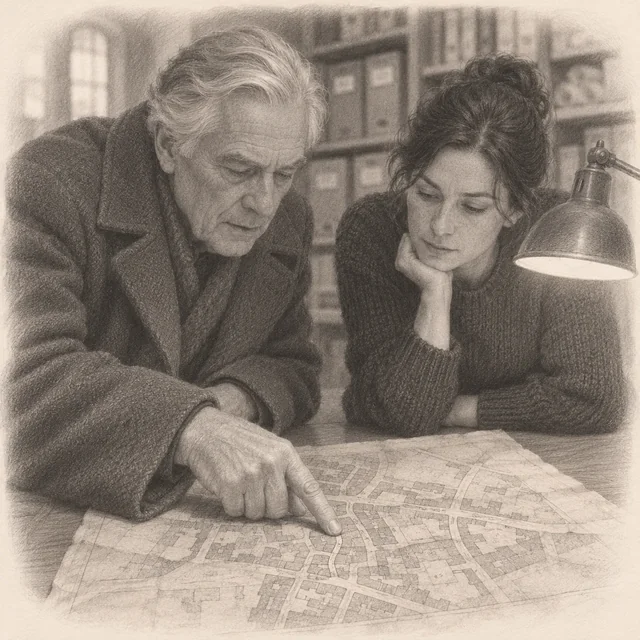
The next day they went to the town archives. Nora had taken the day off. Emil was annoyed about that until the archivist laid an old street map in front of them. A long building was marked where the car park now stood: West Public Baths, demolished 1924.
“A hundred and two years,” Nora said quietly.
Emil pointed to a narrow passage that wasn’t labelled on the plan. “They handed out towels here. Behind it there was a window onto the coal yard.”
The archivist brought out a second plan, a proposal for alterations from 1909. On the back, the words linen room and coal yard were written in pencil.
He ought to have been pleased. Instead, he felt sick. If the memory didn’t belong to him, who had opened the door in his head?
On the way home, they bought bread and cheese. Nora insisted that Emil have lunch. He saw it as one more measure to manage his condition and resisted until she put the knife down.
“I’m hungry too,” she said.
He apologised. Then they sat at the table and talked about her work. Nora restored furniture. That day she was meant to fix a drawer in an apothecary’s cabinet that had been sticking since winter. It did Emil good to hear about a problem caused by warped wood.
Later he went into the bedroom alone. Two of his wife’s jackets still hung in the wardrobe. He’d given the others away, but kept these two because they didn’t smell of anything in particular. They didn’t smell of hospital or of a perfume he associated with one particular occasion. If he slipped his hand into a pocket, he could believe for a moment that she’d just gone shopping.
There was a slip of paper in the right-hand jacket. Potatoes, soap, batteries. Emil recognised her handwriting at once. But he could no longer remember the day she’d last gone shopping. Suddenly he resented the bathhouse. There was room in his head for a green door that had existed long before he was born. There was none for the last ordinary afternoon with his wife.
He took the note into the kitchen. Nora read it without asking why he’d kept it.
“Do you remember how she was always looking for her gloves in winter?”
Emil nodded. His wife used to leave them in odd places. In the bread bin, on the television, once on the shoe rack between two wellington boots. They’d laughed about it. At the time, Emil hadn’t thought he’d soon come to dread every misplaced thing himself.
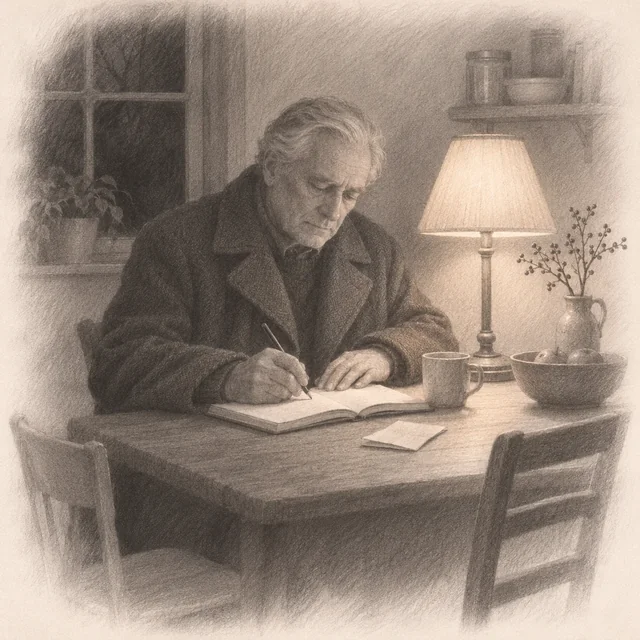
Nora suggested keeping one notebook for the bathhouse and another for memories of his wife. Emil shook his head. He didn’t want to divide his life into two books, one with the useful memories and one with the others.
“Then just use one,” she said, and took a blank notebook out of her bag.
So on the next page he wrote about the gloves. It was only nine lines. As he wrote, he remembered how his wife had once tucked both pairs into his coat pockets because he’d complained about cold hands. He couldn’t quite hear her voice. He could see the movement of her hand clearly.
That evening he phoned his doctor. He told him about walking out in his slippers and about the images. He didn’t leave out the historical evidence, but he didn’t use it as proof that everything was fine with him either. The doctor listened and made an appointment. He said they needed to look at both things: the forgetting and what Emil took to be memories.
When Nora left, she didn’t insist on taking the key. She’d had one for ages. She only asked if she could phone the next morning.
“You can call even if nothing’s happened,” Emil said.
After she left, he slipped the shopping list into his notebook. The bathhouse could wait for one night. He read the nine lines about his wife again and added a sentence about her red mittens.
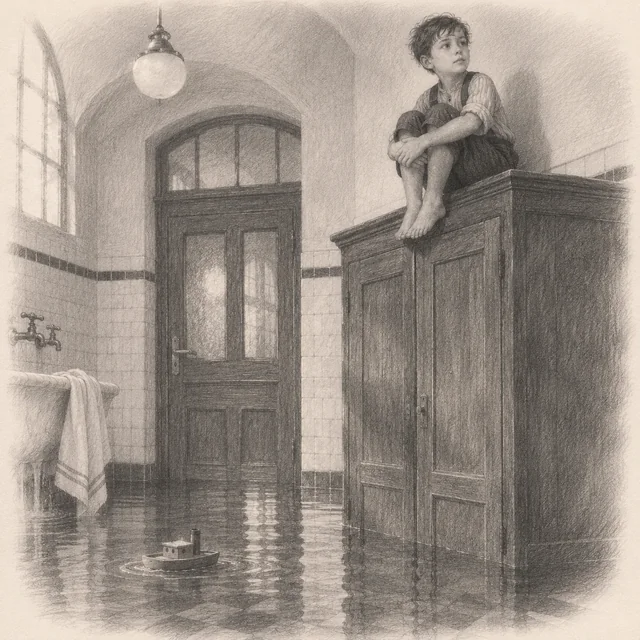
The images came at night now. Water rose over black tiles. A woman lifted her skirts and laughed as though the flood were an inconvenience she’d tell people about over dinner later. A man pounded on a locked door. Emil felt the man’s fist in his own hand. The cupboard was the worst part. The boy sat on top, and little pieces of wood floated beneath him. Emil knew with a child’s certainty that those pieces had once been toys.
He went back to his notebook. Between the memories of his wife, he wrote down the images from the bathhouse, including the gaps. No face was entirely clear. Nobody had a name. Everything he knew was below an adult’s eye level. Door handles loomed above him. When someone spoke, the first thing he saw was their hands.
“You’re not the man getting the boy down,” Nora said when she read the notebook.
Emil understood before she said the next sentence.
“You’re the boy.”
In the newspapers from 1923, they found a flood, a collapsed footbridge and a report praising the evacuation of the public baths. The report said that all visitors had been brought to safety in time. Beneath it was a list of the rescuers. At the very end: caretaker Anton Mahr, singled out for his composure.
At the name, Emil had to leave the room. He went as far as the washbasin in the lavatory, ran the cold water and waited for the shaking to stop. He remembered keys. A heavy bunch knocking against a knee. And a man’s voice: I haven’t got time for you lot now.
The archivist’s name was Selma. When Emil came back, she’d already made a copy of the report. “There’s an admissions register from the children’s home as well,” she said. “I don’t know if it’s connected.”
The home had housed children whose parents worked in the factories or were no longer alive. Once a week, they were taken to the baths. Four names had been crossed out on the day of the flood. Next to them, it just said: placed elsewhere.
Emil read the names aloud. His voice caught on the third. Jakob Seidel, eight years old.
Suddenly he saw a hand with a missing fingernail. It was gripping the edge of the cupboard. It was his hand and yet it wasn’t. He felt his right index finger. The nail was healthy and smooth.
That evening, Emil told Nora something he hadn’t told anyone in decades. His mother had worked in a care home as a young woman. When Emil was little, she sometimes took him with her. He used to sit with an old man who carved wooden animals for him. One was a fox without a tail. Emil had asked why, and the man had said: Because not everyone comes out of the water whole.
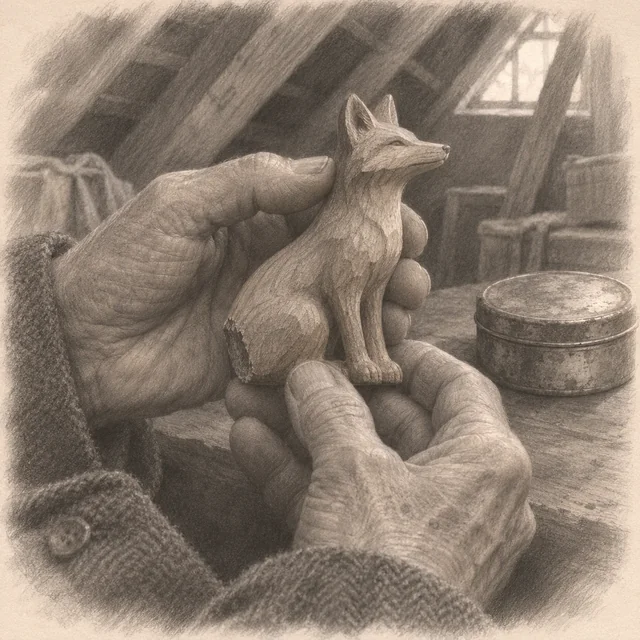
Nora found the fox in a tin in the attic. Emil took it in his hand. Its body fitted exactly between his thumb and index finger. Before turning it over, he knew there was a J carved underneath.
“Jakob told you about it,” Nora said. “Maybe over and over.”
It was an explanation Emil could hold on to. The smell of oranges, the door, the water: an old man’s stories, sunk into a child’s mind and forgotten there. But where had the anger at the caretaker come from? How did he know exactly how many steps there were?
They found Jakob’s niece in a village by the river. She was eighty-nine and had an excellent memory, as long as nobody asked her to remember what a new gadget was called. When Emil set the wooden fox on the table, she pulled back her hand.
“That was for little Emil,” she said.
Jakob had survived the flood. Three other children hadn’t. The caretaker had locked the cellar because he claimed children from outside were stealing coal there. Jakob had got out through a ventilation shaft. Nobody had believed him. They’d put his account down to fever. Later, he’d stopped talking about it.
“Except to children,” his niece said. “He said at least they asked what happened next.”
She gave Emil an envelope. Inside was a clumsy drawing of the bathhouse, in thick lines. Above the cupboard was a sentence: This is where we waited. Underneath were four little figures. One had a circle around it.
On the way home, Nora wanted to know if Emil felt relieved now.
He looked out of the train window. “I still don’t know what I actually remember.”
“Maybe it’s enough to know who was speaking.”
But a private explanation for his fear wasn’t enough for Emil. He wrote to the town authorities. They replied politely, regretted the gaps in the records and referred him to the newspaper account from the time. The honoured caretaker had helped rebuild after the war. They couldn’t rename a lane named after him on the basis of unverified childhood memories.
Emil hadn’t asked for it to be renamed.
He sat down with Selma. They found payroll lists, a death certificate issued late and an invoice for three small coffins paid for by the poor relief office. Little by little, that note in the margin, placed elsewhere, acquired a weight that no polite letter could carry.
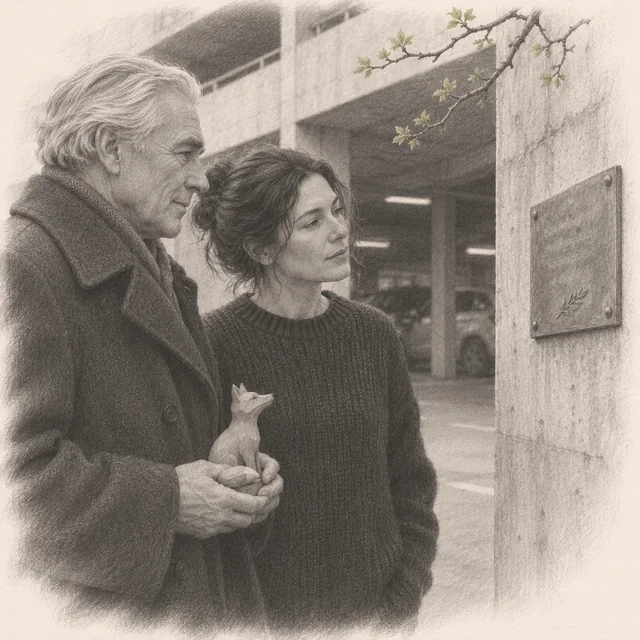
In spring, twelve people gathered outside the car park. No television crew came. A town employee screwed a small plaque to the wall. It bore the names of the three children and a sentence about Jakob, who had survived and given his account. Emil read the inscription twice. The word accident wasn’t on it. That had mattered to him.
When the others had gone, Nora stayed with him. Emil set the fox on the low ledge by the wall. He looked at it for a while, then put it back in his pocket.
“I thought you were leaving it here.”
“It isn’t for the wall.”
That night Emil dreamt of the bathhouse. The water was still there, and the cupboard, and the boy with the injured finger. But this time the green door stood open. Emil couldn’t see what lay beyond it. He didn’t need to. He waited until Jakob had climbed down.
In the morning he remembered the dream and wrote it in his notebook. Then he drew a line beneath it. The memories might come back. The doctor hadn’t been able to promise otherwise. There would still be days when he forgot an appointment or stood in the middle of his flat without knowing what he’d been looking for.
So he wrote a new sentence on the first page of the notebook, for Nora to read if he could no longer explain it himself: This was Jakob’s story. I only kept it safe.
Then Emil put on his shoes. He went to the bakery without losing his way. On his way back he took the longer road along the river. He held the fox in his coat pocket, and for the first time the missing piece of its tail no longer felt like a riddle.