The Second Key
The key was in an envelope marked only: Do not throw away. Leon found it three days after his mother’s funeral, between warranty papers and a collection of old tickets. It was small, made of brass, with a slightly bent bit. The tag bore an address he didn’t recognise.
He put it with the things he’d decide about later. That pile was now bigger than everything he’d already dealt with.
His mother had lived in the same flat for thirty-nine years. Leon knew the drawers, the switches, the sound of the balcony door. Yet as he cleared the flat, he kept coming across things he didn’t recognise. A concert ticket for two. A silk scarf with a burn hole. A photograph of a dog they’d never owned.
The address on the key was across town. Leon went there on Saturday. The building had four storeys and a hair salon on the ground floor. There was no name on the bell for the second-floor flat. The key opened both the front door and the flat.
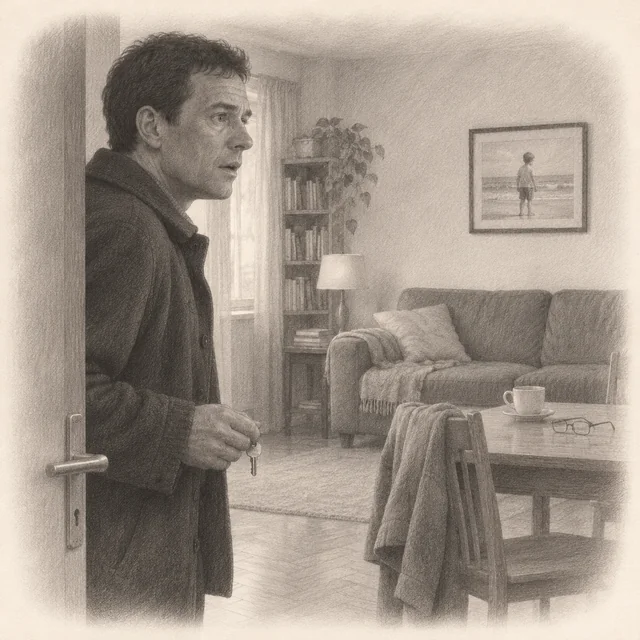
Inside, it smelled of coffee. Leon stopped on the threshold. Someone had draped a blue coat over the back of a chair. There was a cup on the table and a pair of glasses beside it. The flat looked as though someone had just stepped out to check the post.
A photograph of Leon hung above the sofa. He was about six, standing by the sea, holding a dead crab between two fingers. He knew the picture. In his childhood home it had been a small print in an album. Here it had been enlarged and carefully framed.
Leon left the door open. He called down the hall, got no answer and went to the window. Below, a man pulled an empty shopping trolley over the paving stones. When he looked up and saw Leon, he stopped.
A moment later Leon heard footsteps. The man appeared in the open doorway. He was older than Leon, perhaps in his late sixties, and still held the trolley by its handle.
“You’re early,” he said.
“Who are you?”
The man set the trolley down. “Arno.”
Leon looked at the photograph again. “Do we know each other?”
“No.”
Arno asked him to sit down. Leon stayed on his feet. He wanted to know why his mother had had a key to this flat. Arno took the blue coat off the chair and hung it in the hall.
“She came on Tuesdays. Sometimes Fridays too.”
Leon waited. The simplest explanation seemed so obvious that he was ashamed to say it aloud. His mother had lived seventeen years after his father died. Why shouldn’t there have been a man? Why hadn’t she told him?
“She read my letters to me,” Arno said.
It wasn’t the answer Leon had prepared himself for.
Arno could read, but not reliably any more. Lines slipped out of place, and numbers vanished among other numbers. After a stroke he’d had to learn some things again. The authorities had approved support, but he hadn’t liked the constant change of helpers. Leon’s mother had stayed.
“And the photograph?”
Arno looked at the wall. “I suppose you’ll have to take it with you.”
Leon felt a kind of anger he had nowhere to put. It wasn’t about the letters. It was how comfortably his mother had belonged in this flat, where she’d had a cup, a coat and apparently an afternoon of her own.
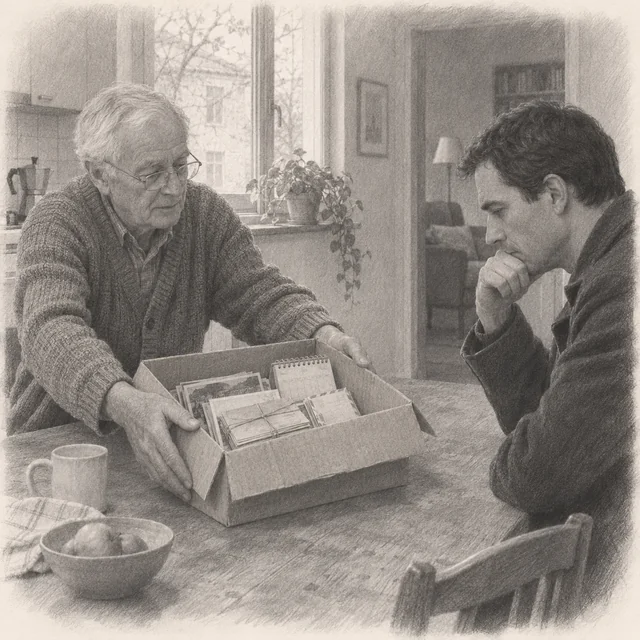
Arno took a cardboard box from the cupboard. It held postcards, bills and a small calendar. Her name was written on many of the Tuesdays. On another sheet she’d written some exercises: bread, boat, ground. Beside them were shaky repetitions in Arno’s handwriting.
“How did you meet?”
Arno looked at his hands. “Through your father.”
Leon’s father had been a construction site manager. He’d died in a car crash just as Leon was starting his first job. A lot of him had survived in family stories: his punctuality, his bad coffee, his knack for turning a breakdown into an outing.
Arno had been injured on one of his building sites. A piece of scaffolding had struck him on the head. The stroke had come later and was a separate event, though Arno told both stories in the same quiet voice. After the accident there’d been arguments over reports and responsibility. In the end, Leon’s father had said he didn’t know Arno personally.
“But he knew you.”
“Yes.”
Leon finally sat down.
Years later Arno had written his mother a letter. He wasn’t asking for money. He wanted to know whether her husband had kept the old crew list. She’d found the list and come over. Then she’d come back.
Leon didn’t take the box. He left the key on the table and went out. In the street he called his sister. She said she’d heard of an Arno but had thought he was one of their mother’s neighbours. Then she asked whether Leon had eaten anything.
It made him almost angrier than anything else. The world couldn’t just carry on asking questions like that.
For two more days he cleared the flat. He found the crew list in a folder marked Garage. Arno’s name was highlighted. There were also letters from an insurance company and a copy of his father’s statement. Leon read it at the kitchen table. Then he read it again because he’d hoped he’d misunderstood it the first time.
His father had known that one of the fixings was faulty. He’d reported it verbally, but hadn’t made sure work stopped. In his later statement, what he’d known had become a suspicion, and the suspicion a gap in his memory.
His mother had written a sentence in the margin of one copy: That explains why. It doesn’t make it right.
That evening his sister came over. Her name was Tessa, and she brought two empty boxes. Leon had asked her to read the papers herself. While she sat over the folder, he took down the curtain rail in the living room. There was no need to do it, but it kept his hands busy.
Tessa read more slowly than he did. She put the papers back in the order she’d found them. Then she asked if there were any more. Leon showed her the second folder. Together they looked for a letter that explained things differently. They found none.
“He told us about an accident once,” Tessa said. “I remember asking if anyone had died.”
Leon didn’t remember.
“He said no. I didn’t ask anything else after that.”
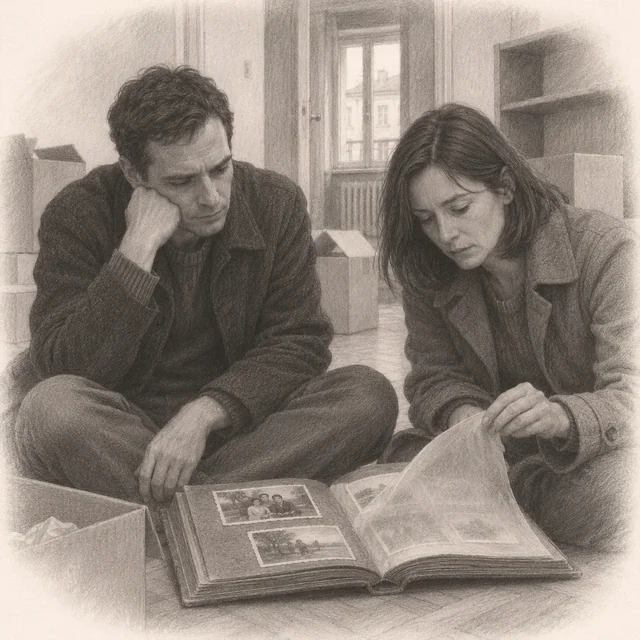
They sat on the floor because the chairs had already been collected. The box of family albums stood between them. Tessa opened one and turned to a summer holiday. Their father was sitting on a wall holding an ice cream that was melting over his fingers. Leon had taken the picture.
“I don’t want to pretend now that everything about it was false,” Tessa said.
Leon ran his finger over the plastic sleeve. That was exactly what he’d been afraid of. That this new story would overwrite all the old pictures until there was nothing left he could think of without reservations.
They argued about whether their mother should have told them. Tessa thought she’d had no right to carry it alone. Leon defended her at first, then realised that was just another role he slipped into out of habit. He didn’t know what had moved her. Shame, perhaps. Perhaps she’d wanted to let them keep the father they’d known. Perhaps every Tuesday she’d thought she’d tell them the following weekend.
In the kitchen they found two kinds of tea neither of them had ever drunk. Tessa held up a tin.
“For Arno?”
“Maybe for herself.”
They left the question open. It was the first one that day they hadn’t tried to answer straight away.
Later Leon called a former colleague of his mother’s. He asked how she’d been in her last few years. The woman told him about a day trip, an argument at the gardening club and how his mother had wanted to go swimming again. Leon wrote nothing down. He just listened.
Tessa spent the night on a mattress in the living room. Before they switched off the light, she asked if she could come along the next time he visited Arno. Leon said he’d have to ask him first. His sister nodded. They both sensed that this mattered. Arno was a person who could open the door to them or leave it shut. The key hadn’t made him part of their inheritance.
In the morning Leon made coffee in his mother’s old machine. He drank it on the balcony and watched the neighbours water their plants. He still had questions. For the first time since finding the key, though, he knew which ones he wanted to ask Arno and which weren’t Arno’s to answer.
Leon went back to Arno’s. This time he rang the bell. The key was still on the table.
“You can keep it,” Arno said. “Your mother wanted you to have it, in case I needed help.”
Leon looked at him. “She just decided that?”
“She hoped.”
They sat in silence for a long time. At last Leon asked why his photograph was there.
Arno told him about a Tuesday in November. His wife was already dead. He’d told Leon’s mother that some weeks he didn’t see a single face he really knew. She brought the photograph on her next visit. It wasn’t meant to replace anyone. She said it was her son back when he used to turn over every stone. Arno might as well know who she was always talking about.
“She talked about me a lot?”
“Sometimes too much,” Arno said.
For the first time, Leon laughed.
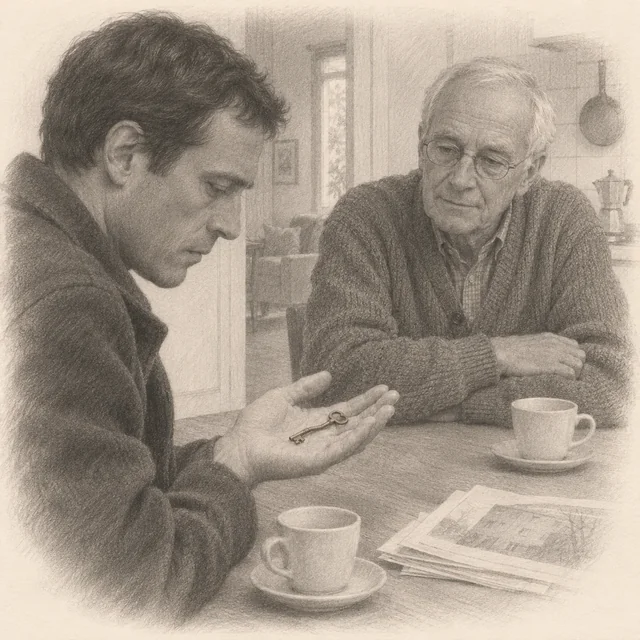
He put the copies on the table. Arno looked at them without reaching for them. He knew what they said. He didn’t know every word, but he knew what they’d meant for his life.
“Should I do something?” Leon asked.
Arno shrugged. “What do you want to do?”
Leon had hoped there would be a clear task. A claim, a letter, a sum of money. Something he could do and then cross off. Arno gave him none of that.
“I can’t excuse my father.”
“I didn’t ask you to.”
“And I can’t just come every Tuesday.”
“I didn’t ask you to do that either.”
Leon took the key in his hand. It no longer felt like something he’d found. It felt like something he had to accept or give back.
Over the next few weeks he helped Arno find reliable day-to-day support. They met people, turned down two arrangements and eventually found a woman whose dry humour Arno liked. His mother had had her own place in Arno’s life. He came by on some Saturdays. They drank coffee and talked about football, though neither was particularly interested in it.
He went through the old papers with his sister. They gave Arno copies and asked an advice centre whether any claims could still be pursued. Much of it had happened too long ago. They could at least set some things straight. Leon learnt to tell the difference between justice that had been missed and harm that could never be made good. Both hurt, in different ways.
The photograph stayed above the sofa. Arno offered it to him twice more. Leon declined. He’d found the small original in the album and didn’t need a second one.
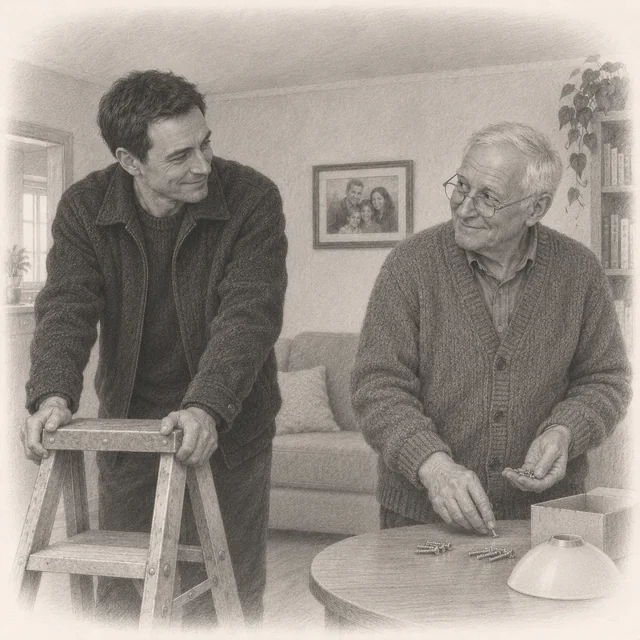
One Saturday Arno asked him to help put up a new light. Leon held the ladder steady while Arno sorted the screws. Above them was a grey patch on the ceiling where the old fitting had been.
“Your father would’ve done it quicker,” Arno said.
Leon looked down at him. Arno grinned.
“Probably,” said Leon.
On the way home he passed his mother’s flat. The new tenants had put flowers on the balcony. Leon didn’t stop. In his jacket pocket were his own keys and the little brass key with the bent bit.
He no longer carried it out of duty. The week before, Arno had asked whether he could leave a spare key in case Leon ever locked himself out. Since then, there’d been a second key hanging on the inside of Leon’s front door too.