The Last Craftsperson
The city reported the fault at twelve minutes past six. There was no alarm, just a polite message on Mara’s kitchen wall: Irregularity in the domestic water circuit. No disruption to your comfort is expected.
Mara put a saucepan under the dripping tap. Then she cleared the message. She hadn’t had a job from the city in nine years. People came to her workshop for small repairs when they couldn’t bear to part with something: a mechanical doll, a knife with a broken handle, a clock whose owner didn’t need the exact time but wanted the sound of her father on a Sunday morning.
The tap kept dripping. Mara bent beneath it, removed the casing and found a seal that had disintegrated into a sticky ring. She cut a replacement from an old mat. By seven, the kitchen was dry.
At eight, two city employees arrived.
They wore the blue jackets of the municipal utilities department that Mara knew from her apprenticeship. Their hands were clean. The younger one introduced himself as Lio, the older woman as Ms Venn. They didn’t want to see the seal. They wanted to know how Mara had opened the casing.
“With a screwdriver.”
Lio looked at Ms Venn. “That model isn’t designed for user access.”
Mara showed him the screw.
Ms Venn asked if she could come with them. In the car she explained that a water supply unit in the north district had failed. The automated system was requesting a component whose reference number no longer existed in the manufacturing catalogue. A second system was waiting for approval from the first. The flats still had water, but only from reserves.
“How long?”
“Until tomorrow. Maybe only until this evening.”
Mara fetched her toolbox from the workshop. Before she got in the car, she turned over the sign on the door. Back soon, it said. She hadn’t used it in years.
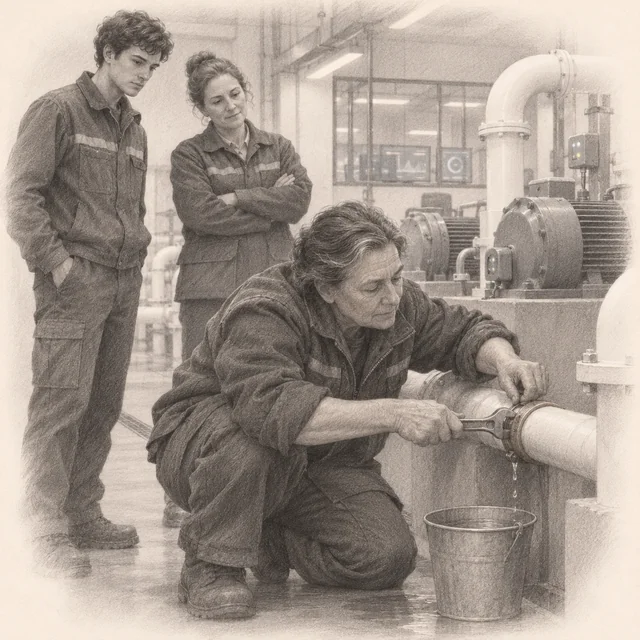
The water supply unit lay beneath a square shaded by artificial trees. A maintenance hatch opened when Ms Venn placed her hand against it. Inside, pumps hummed in a white room. Everything was labelled. Everything was clean. In the middle stood an orange bucket.
“We put that there ourselves,” Lio said apologetically.
Mara knelt beside it. Water was leaking from a small section of pipe, no faster than from her kitchen tap. The difference was the pressure. She put two fingers on the metal and felt a slight vibration.
“The pump’s kicking back.”
“The pump’s already been replaced three times,” said Lio.
“Then you’ve got three broken new pumps.”
In the control room he showed her the repair sequence. The system had checked a valve, replaced a pump and then traced the fault to a sensor. The sensor was no longer available. Everything else depended on replacing it.
Mara looked at the drawing. “Where’s the return line?”
Lio enlarged the image. There wasn’t one.
There certainly was one downstairs. It ran behind the wall, thinner than the main line and painted the same white. Mara tapped it. The pipe sounded hollow up to a point where it suddenly gave a dull thud.
“It’s clogging up,” she said.
Ms Venn asked whether the city could issue a repair order for it.
“You can give me permission to open up the wall.”
Ms Venn wasn’t allowed to do that. The wall was part of a certified supply system. Damaging it would invalidate its operating permit. Lio wrote a request. Within a second the system replied: Valid documentation for the affected line is required for assessment.
Mara sat on her toolbox. “So now we wait for a drawing of something that isn’t on any drawing.”
At noon, the pressure dropped in the north district. The city distributed drinking water in sealed containers. A message on the walls of the flats asked residents to refrain from taking baths temporarily for reasons of sustainability.
Mara ate her sandwich in the basement. Lio stayed with her. He was twenty-two and had studied utilities engineering. His studies had consisted of simulations. In those simulations, the machines had never refused to open a wall.
“Are you really the last one?” he asked.
Mara finished chewing. “The last registered craftsperson. There’s a woman in the south who winds motors. And a man who cuts glass. The city calls us practitioners of historical working methods.”
Lio didn’t smile.
Mara asked why the return pipe might be missing from the drawing. He thought for a long time. Finally he said it had probably been fitted later, before everything was catalogued digitally.
“Or someone left it out when they were making the catalogue,” Mara said. “Both things happen.”
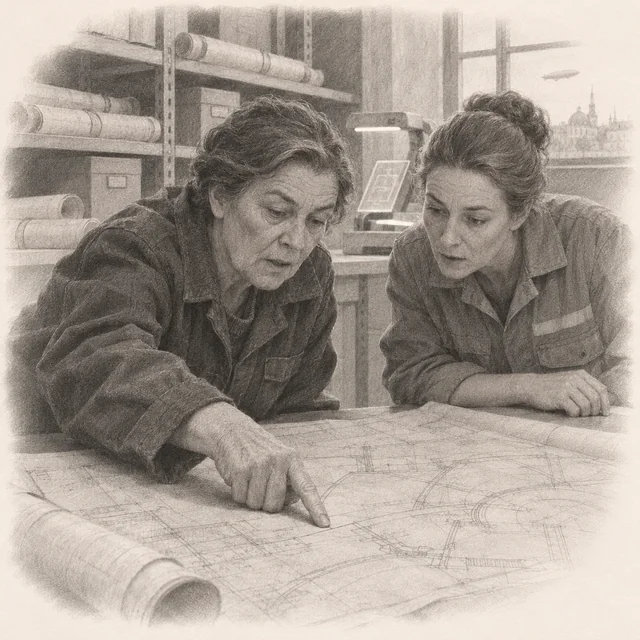
They went to the utilities archive. The machines found no drawing. An old storekeeper found a box of paper rolls. He used them to put under wet boots. On the third roll Mara spotted the pipe, drawn in red pencil. Her own name was beside it.
She’d fitted the line as an apprentice. Forty-three years earlier. The plant kept overheating, and her supervisor had improvised a return line. The official conversion was supposed to follow. Mara remembered him saying: We’ll draw it up properly tomorrow.
Apparently, tomorrow had never come.
Ms Venn looked at the signature. “This proves the line exists.”
“It also proves I made an unauthorised change.”
“You were an apprentice.”
“I was there.”
Ms Venn said nothing. For the first time that day, she looked less like a representative of the city than a woman facing an uncomfortable decision.
That evening they opened the wall. Ms Venn had accepted responsibility using her personal ID. There was nothing heroic about it. She’d read through the possible consequences three times beforehand.
The line was almost completely blocked with deposits. Mara could have cleared it. It would have taken hours and might not have lasted. The stores had suitable pipes but no fitting for the old thread.
Lio suggested making a copy of the fitting. The manufacturing system declined the order because the model wasn’t certified.
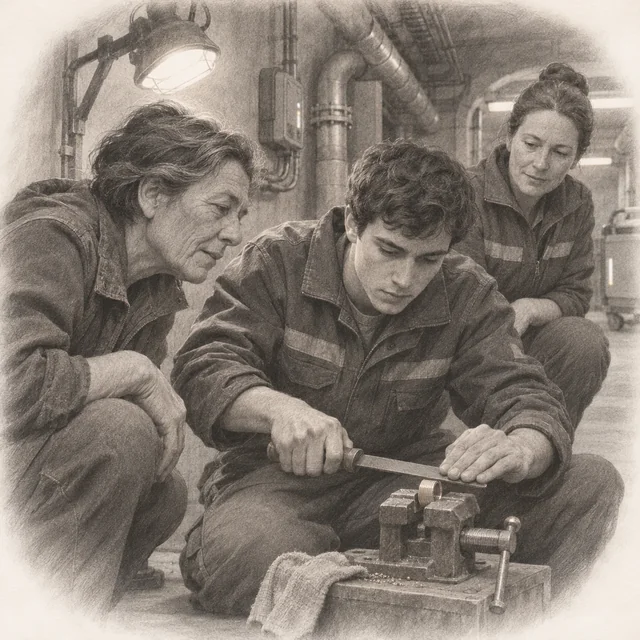
Mara set a small vice on the floor. She took a piece of brass from her toolbox, clamped it in place and began to file. Lio watched. After a quarter of an hour, she handed him the file.
“Don’t press it like you’re pressing a button. Listen for when it bites.”
He gouged the metal, swore and immediately apologised. Mara pushed the toolbox under his feet so he could stand a little higher. The second try was better. They worked past midnight. Ms Venn brought soup in paper cups. Nobody spoke about whose job it was any more.
When the thread finally fitted, Lio screwed the fitting in. Mara let him do every part himself. Only once did she put a hand on his wrist, just before he used too much force.
They opened the circuit slowly. The vibration stopped. The pumps ran quietly. In the control room the screen still said: Awaiting sensor replacement.
Lio laughed for the first time.
The next morning water was flowing again in the north district. The city thanked the utilities department for restoring the supply so quickly. Mara received a letter asking her to submit an invoice under an approved service category.
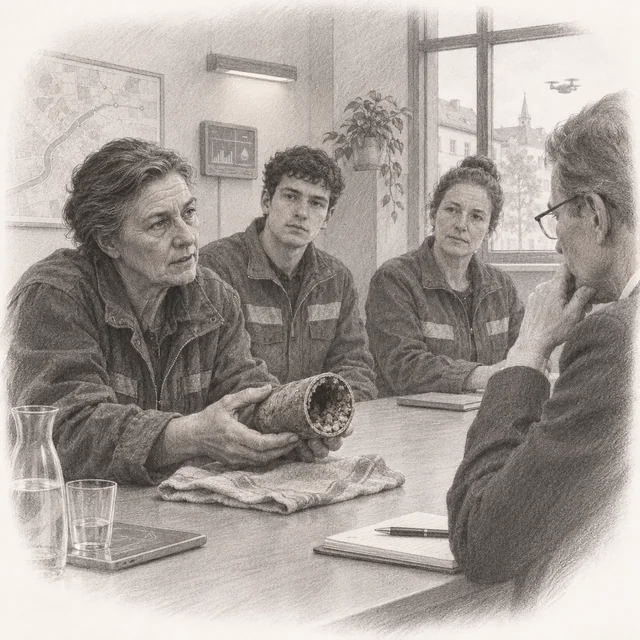
Ms Venn temporarily lost her authority to approve work. The proceedings lasted three weeks. Mara was called to a hearing. They asked why she hadn’t waited for the system’s decision.
She set the clogged pipe on the table. It rested on a soft cloth so it wouldn’t leave scratches.
“Because you’d run out of water.”
The chair said that wasn’t the issue.
“Then perhaps you should talk about what the issue is.”
The hearing ended without an apology. Ms Venn got her authority back, with new conditions attached. Mara’s invoice was paid. Lio turned up at the workshop the following Saturday. He didn’t bring anything broken. He brought a notepad.
“I’d like to learn how to cut a thread.”
Mara pointed to a chair. “First you’ll learn how to tell whether you need a new one at all.”
One student became four. Then seven. The city offered a bright room in the utilities building. Mara turned it down after reading the conditions. Every job carried out there would have needed prior approval from the automated system.
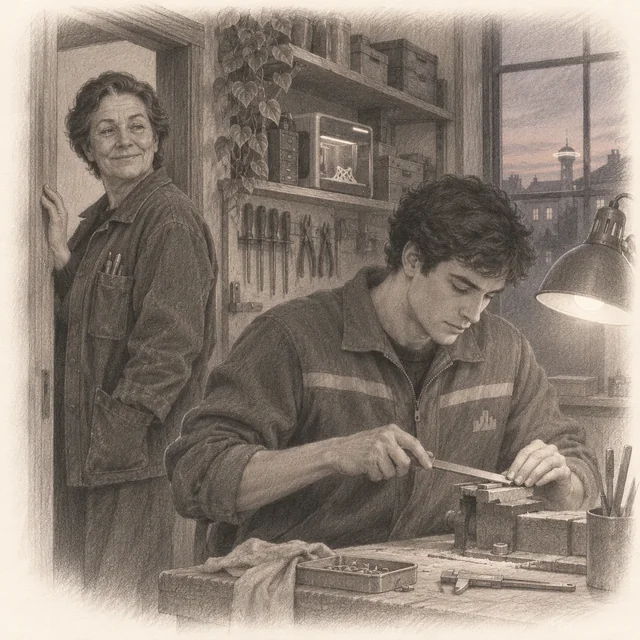
Instead she cleared out the storeroom behind the workshop and put in two benches. Ms Venn came on Thursdays after work and learnt how to take a tap apart. She was patient and excellent at documenting things. Lio wrote down what went wrong with each attempt. Mara liked that better than his neat drawings.
One day he brought a new sign. Utilities and Repair Workshop, it said. There was room for names underneath.
“Yours is missing,” Mara said.
“I’m not finished yet.”
She picked up a pencil and wrote Lio on the wood. “Neither am I.”
She didn’t put the newspaper article calling her the last craftsperson back in the window. She put it in a drawer beside the old drawing with the red return line. Both were worth keeping so someone could look back later and see how it had come to this.
As she locked up that evening, she heard Lio’s file behind her. He worked more slowly than she did, still pressing too hard. Mara wanted to say something. Then she let him carry on. He’d hear where it was going wrong. And if he didn’t, he could ask her tomorrow.