The Light Across the Street
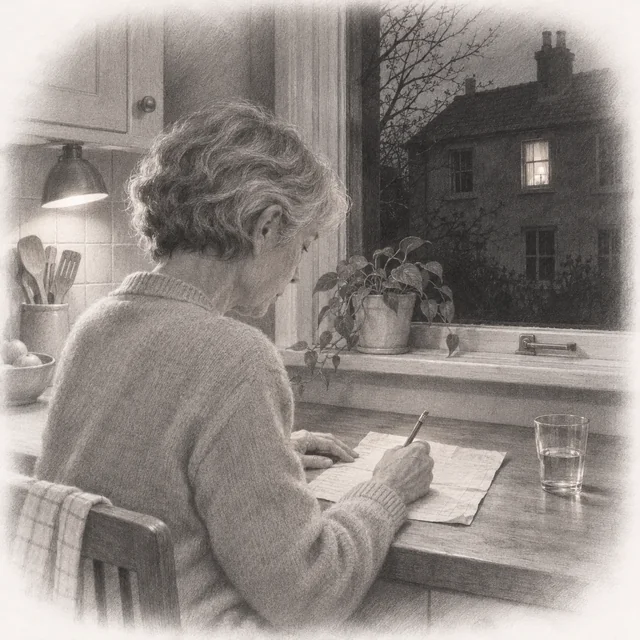
There hadn’t been a light on in the house across the street for years. So Ruth noticed when a pale light flashed three times upstairs. She was standing at the kitchen window drying a glass. Short, long, short. Then the house went dark again.
Ruth had once worked as a radio operator on a cargo ship. Later she’d worked in a shipyard office, and finally she’d looked after her mother. Of those three stretches of her life, she liked talking about the ship best. Nobody was interested in the office, and she couldn’t find a way to talk about caring for her mother that didn’t sound like complaining.
She set the glass down and waited. Half an hour later the light came back. It lasted longer this time. She got a pencil, wrote the sequence on an old bill and decoded the signals. They didn’t spell words. Just five digits: 03117.
The next morning she went across. The garden gate hung crooked, and the windows were boarded up except for the little room upstairs. There was a notice from the town on the door. Demolition once the building is secured. No entry. Ruth rang the bell anyway. She heard nothing.
Her neighbour Paul saw her from the pavement. “Nobody lives there,” he said.
“There was a light on last night.”
“Teenagers.”
Paul had an explanation for almost everything that involved teenagers. Ruth let him walk on and studied the ground outside the door. A narrow, fresh streak ran through the damp dust. Someone had dragged something heavy into the house.
At seventeen minutes past ten that evening, the next sequence began. 03117, then 04102, then 05144. Ruth wrote them down. The lamp didn’t move. It switched on and off in the same spot, at such precise intervals that someone must have been using a timer.
Ruth tried the numbers as dates, phone numbers and coordinates. Nothing fit. Then she tried reading them as references to a book. Page three, line eleven, word seven. But which book?
She remembered the shop on the ground floor. A man named Heller had sold and repaired radios there. As a child, Ruth had stood outside the shop window watching the illuminated dials. After Heller died, his wife lived upstairs on her own for a few more years. They’d had no children, at least none Ruth knew about.
In a drawer she found a receipt from the shop. Her father had bought a record player there in 1968. The shop emblem was on the back: a tower with three bolts of lightning. Below it were the words: We bring voices home.
On the third evening, the lamp started flashing earlier. Ruth opened her window. With a torch, she slowly signalled the word WHO.
Nothing happened for a minute. Then a face appeared in the window across the street. It was only a pale blur behind the glass. The light went out. Ruth heard a door slam downstairs, and a little later footsteps on the pavement.
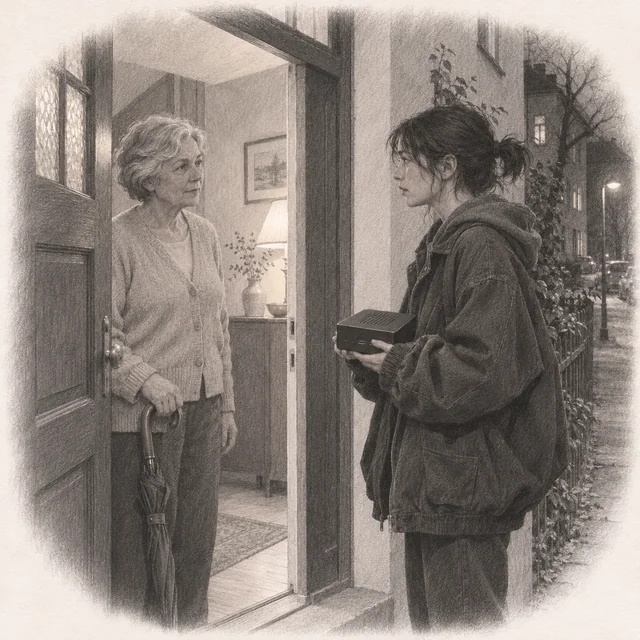
When her doorbell rang, she took the heavy umbrella from the stand and carried it to the door.
Outside stood a young woman in a jacket much too big for her. She held a small black box in her hand. “Can you really read it?” she asked.
Her name was Juna, and she was Heller’s great-niece. The house was due to be demolished in two weeks. Her mother had turned down the inheritance. Juna had gone inside anyway, hoping to find photographs. Instead, she’d found boxes full of tapes in the cellar.
“My great-uncle recorded messages,” she said. “For people who didn’t have a machine of their own. Greetings for relatives. Letters you could listen to. Things like that.”
Ruth put the umbrella back.
There were numbers on the boxes. Juna had found names in a notebook with strings of numbers beside them. She hadn’t known whether the tapes held private memories or old business records. Then she’d come across a voice on one of the recordings, asking over and over for an answer.
“Why the light signals?”
Juna showed her the black box. A small computer switched a work lamp on and off. The numbers came from an old sheet headed Reception Test. Juna had hoped somebody from Heller’s old radio club would recognise them. Ruth’s house was on the list of receiving stations from those days.
Her father. Ruth had forgotten that he’d been in the club before she was born.
“You could have put a letter through the door.”
Juna looked down. “I started because it seemed like a good idea. After that, I felt too embarrassed just to ring the bell.”
Ruth understood that better than she wanted to admit.
The next day they went into the house together. It smelled of plaster, dust and cold wood. The tapes were in the hallway by then. Juna had dragged them up from the cellar on a board, which explained the mark outside the door.
Ruth insisted they go no further into the cellar. The demolition notice was there for a reason. She called the town offices and asked under what conditions they could retrieve the collection. The man in charge sounded surprised that someone had asked before taking anything away. He came that afternoon with a colleague. Together they carried the boxes into Ruth’s garage.
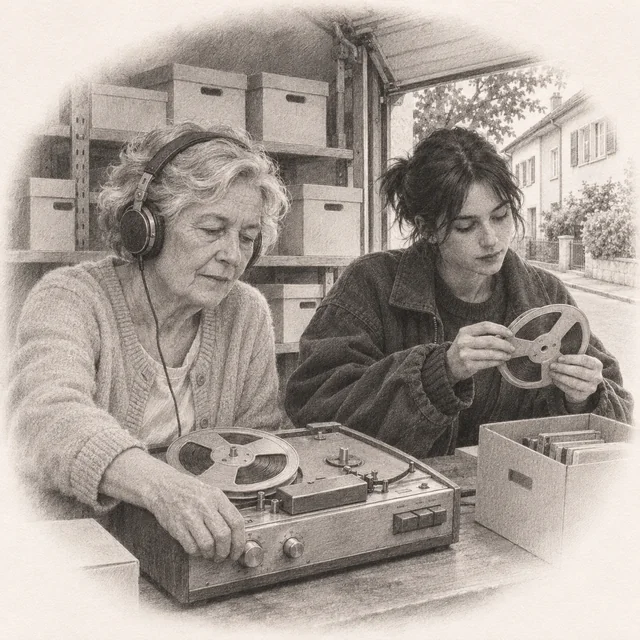
The first recording began with a cough. Then a man said: Dear Lotte, I’m doing well. Somebody whistled in the background. Another man laughed and called out that he ought to say the food was awful. There was a date from 1964 on the box.
Ruth played it twice. It wasn’t her father’s voice. But she remembered the whistling in the background from her childhood.
They worked for a week. Juna labelled the tapes and Ruth checked them. A retired sound technician helped them preserve damaged sections. They put none of the voices online. Instead, they used notices and archives to find the families mentioned on the tapes. Anyone who came to collect a recording could take it without telling them anything.
Some did anyway. One woman heard her grandfather’s voice for the first time. A man brought the tape back unopened. He wanted to keep his mother’s voice as he remembered it. Ruth put the tape in a new sleeve without asking any questions.
On the eighth day they found a recording with no voice on it. Ruth nearly set it aside. Then, behind the hiss, she heard a ship’s bell. She turned down the volume so she could bear the scratch of the old tape and let it run.
A man counted slowly to ten. After a long pause, he said the same sentence in two languages. It was clearly a test tape, made somewhere in the harbour. Ruth remembered the narrow radio room on her first ship. A chair whose back was too low, a fan, and the heat when they waited offshore for a berth in summer.
Juna asked why she’d left. At first Ruth said she’d wanted steady work ashore. That was true. She could have earned more if she’d stayed, but she was tired of hearing about weddings, illnesses and house moves only after they’d happened. Her mother was still healthy at the time. The decision had had nothing to do with looking after her later.
“Do you regret it?”
Ruth took off her headphones. “This morning, yes. Yesterday, no.”
Juna seemed satisfied with that. She didn’t ask another question and labelled the sleeve Harbour recording, location unknown.
That afternoon the sound technician helped them clean a machine that kept jamming. His name was Sander, and he’d once been in charge of films for schools. With every screw, he told a story that ended with an overheating projector. Ruth grew impatient. She wanted to get on with the recordings. It was only when Juna poured him a second cup of coffee that Ruth realised he’d started his story over because nobody had picked up on it the first time.
She asked which school the projector had been in. Sander named a place Ruth had never been. He described the gym, the curtains and the caretaker who’d shut off the wrong circuit. This time they listened to the end. It took five minutes. The machine was no more fixed than before, but Sander went home with a different look on his face.
Later Ruth sorted through the replies. They’d found fourteen families. Three didn’t want the tapes. Two addresses were wrong. One man asked for a digital copy because he had nothing to play a tape on. When he got it, he sent them a photograph of his father. Ruth looked at it for a long time. The man in the picture had probably been younger when he made the recording than Juna was now.
There was also a phone call that didn’t make sense at first. A woman asked whether Ruth had sailed on a ship called Morgenstern. She’d seen Ruth’s name in the newspaper notice. Her brother had been the cook. He used to talk about the radio operator who’d played cards with him through a storm so he wouldn’t think about how far away the nearest land was.
Ruth scarcely remembered the cards. She remembered the cook well. He took every cake out of the oven too early. The woman laughed and said that had never changed.
After the call, Ruth sat for a while with her hand on the receiver. Then she wrote the number on a card. Instead of filing it with the replies, she put it in her own address book. Next Sunday, she decided, she’d call back even if she had nothing to say about a tape.
The tape with the request for an answer was in a tin. It had no number, just a name: Marta. A woman spoke quietly, with long pauses. She’d arrived at the boarding house. The child could stay. She needed the blue notebook from the kitchen drawer. Please answer, Ernst. Please don’t send me back.
Ruth didn’t know what she’d expected. A woman who’d disappeared, perhaps, or an old wrong. Juna found in a register that Marta had been Heller’s sister. The child had grown up under a different surname. The trail ended in a small town a hundred kilometres away.
They wrote a careful letter. Three days later a woman named Erika called. She was seventy-two. Marta had been her mother. She knew nothing about a boarding house, but she certainly knew about a blue notebook.
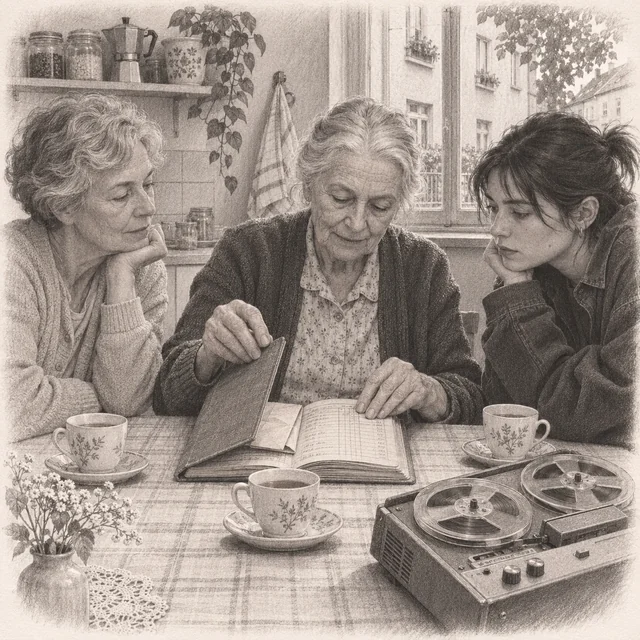
When Erika came, Ruth put tea on the table. Nobody switched on the tape machine straight away. Erika said her mother had gone on to run a dressmaking shop. She’d said little about those early years. The family had never mentioned the name Ernst.
“I’d like to hear it,” Erika said at last.
After the final please, Erika sat still for a long time. Then she took a little blue household ledger out of her bag. A folded letter was tucked inside the cover. Heller had answered his sister. He’d sent money and the notebook, and promised he’d never send her back.
“So the tape isn’t a cry for help that went unanswered,” Juna said.
Erika ran her hand along the spine. “No. It’s the beginning of what became possible afterwards.”
Ruth looked at the still reels. For weeks she’d heard a terrible thing left unresolved. Now there was a whole life on the table that hadn’t been waiting for her to save it.
On the day of the demolition, the three of them stood on the pavement outside Ruth’s house. The upstairs lamp was in the boot of Juna’s car. Erika took only the tape with her. The other recordings would go to the town archives where the families agreed.
When the excavator bucket reached the upstairs room, Ruth went inside. She didn’t have to watch every wall come down. In her kitchen she made three cups of tea and put biscuits on a plate. After a while the two others followed.
Juna asked whether Ruth would teach her Morse. Properly, without a computer.
“Why?” Ruth asked.
“So I won’t have to call you every time I’m standing across the street.”
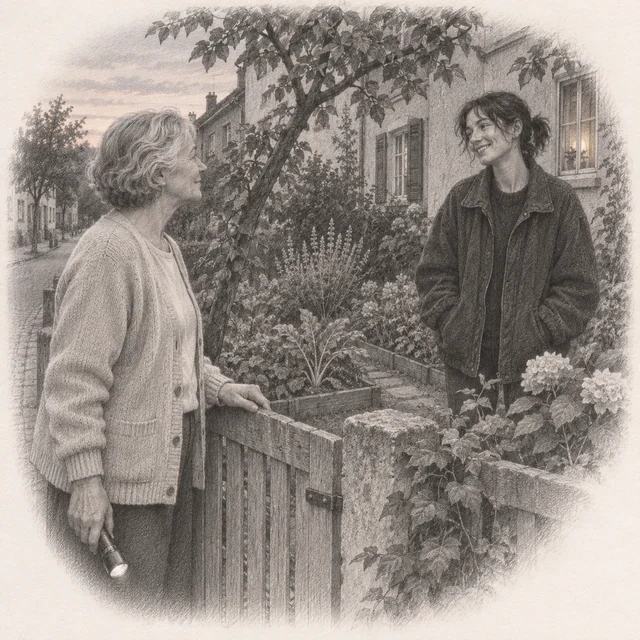
A little garden was planted on the site later. Juna lived two doors down now. Some evenings Ruth saw a brief flash from her kitchen window. No numbers, no urgent message. Just the two letters they’d practised first.
In?
Ruth didn’t need a bill any more to write down the signals. She reached for the torch beside the window and answered. Then she put on her shoes and went over.